
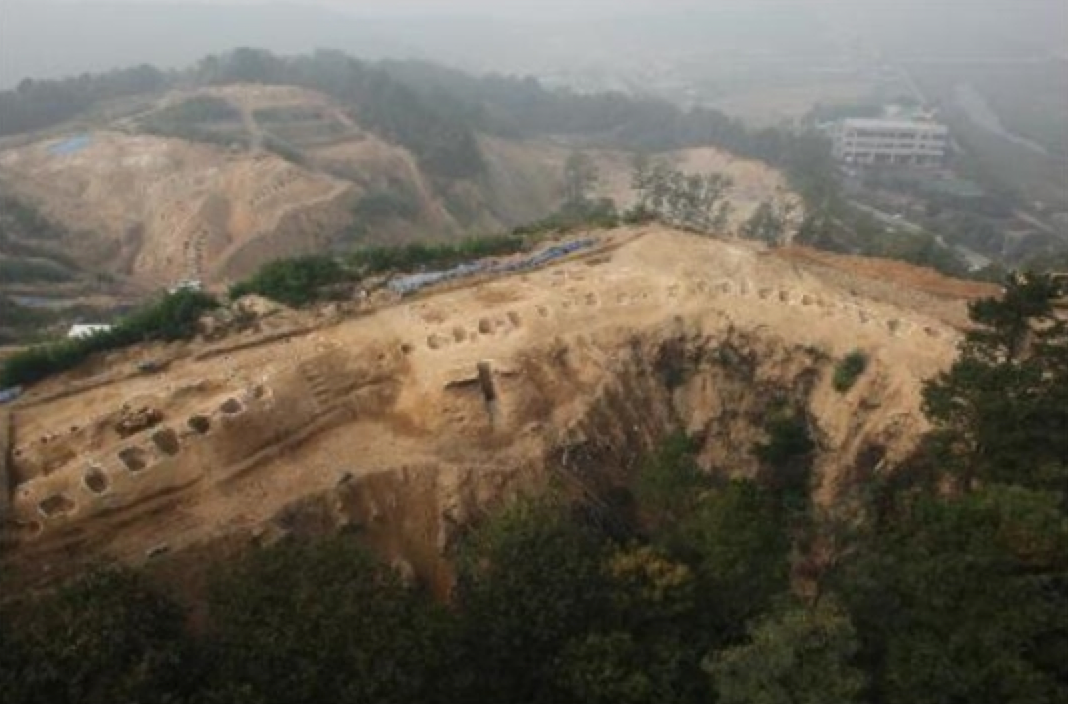
 In Anseong in Gyeonggi province a Baekje wood-walled castle, built between the 4th and 6th centuries, has been discovered. The fortress’ purpose was the block Goguryeo soldiers. Since September the Historical Culture Revival and Protection Association has been undertaking an excavation investigation in the neighbourhood of Dogi in Ansang city, with the result that traces were found of the barriers of the wood-walled castle.
The castle’s position abutting the foothills and the Anseong river provided defences, with 4 sections each running about 130 metres in length. [This structure] is one of the first heaped-earth fortresses with a framework made from the wooden stake barriers erected around it. Catching the eye is the interior built from a single row of earthworks and the exterior built from two rows of earthworks. The gaps between the laid woodpiles is around 4.5m – 5.5m. This toru style of earthwork is characterised by empty space dug behind it like a staircase, carved out of the outer surface of the hill – layered clay lumps [behind it] increase the strength of the wall.
Earthenware pottery, dishes and so on have been excavated from the mounds behind the fences, exhibiting the short neck and lid typical of the gupdari style from the 3rd-4th century of Baekje. A researcher said “up until the fourth century the framework and excavated remains are Baekje, but after this point a Goguryeo army seems to have occupied the castle; it has been possible for the first time to specifically gauge the structure of a Three Kingdoms barrier facility, so this ruin has been evaluated as being very important.”