
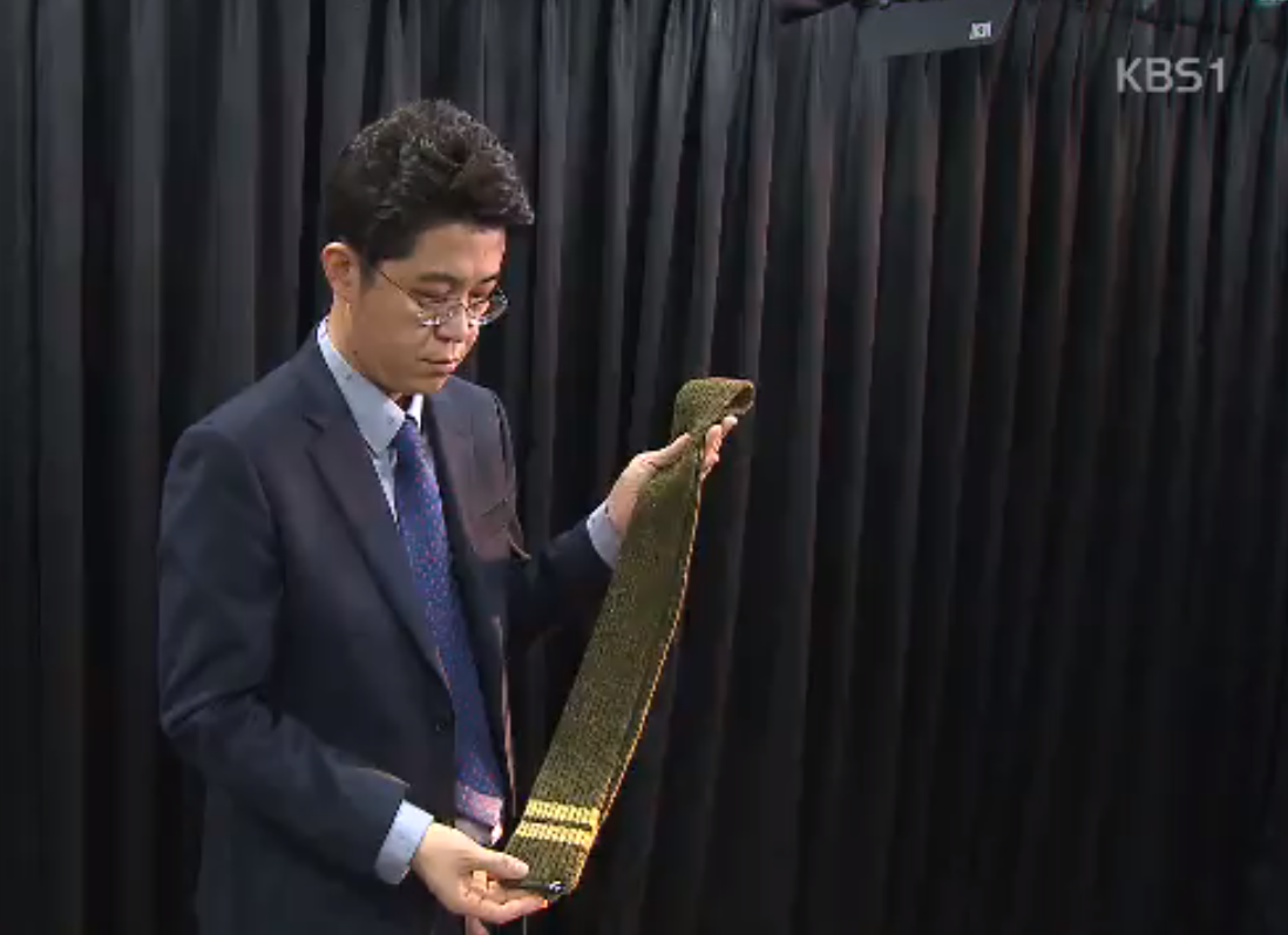
 KBS News – video
E-Land, a fashion firm with yearly sales of ₩10 trillion [around £2.7 billion], has been enveloped in a controversy, having plagiarised the design of some small- and medium-sized enterprises’ scarves. E-Land had promised to provide settlement money and incinerate the [plagiarised] items, but later changed its promise.
[Reporter] From the start of the second half of the year up until this month E-Land has been selling this scarf. However, this design, released a year ago by a smaller business, has almost exactly the same design.
[Representative of the specialist scarf company]: “The length, the width, the position of the stripes, and the size of the stripes, and the composition of the fibres – it’s all exactly the same.” The specialist manufacturer’s version costs ₩68,000 [£37.50], reflecting its development costs, while E-Land’s version sells for ₩23,900 [£13.20] – a third of the price. The [smaller] company’s annual sales of ₩200 million have taken a big hit.
[Representative of the specialist scarf company]: “It’s been very mentally stressful with retail and wholesale account customers ringing up complaining that the exact same product as their expensive scarf is on sale [for a cheaper price].” As soon as the smaller company complained E-Land sent a notice of agreement [합의안 = notice of compliance, perhaps?]. [E-Land] gave a settlement of ₩5 million [£2,700] and undertook not to violate [the smaller company’s] intellectual property rights again, and to remove from sale and burn all of the problem items.
However later, E-Land’s attitude changed.
[E-Land manager]: “If one looks at the photos, one can see that this scarf [designed by the smaller company] is awfully similar to a lot of other scarves from other brands.”
The controversy continues to engulf E-Land.
Analysis: This news piece highlights the curious disregard for intellectual copyright in Korea. Plagiarism is rampant in all spheres of commercial life – perhaps a legacy of the rote memorisation and subordination of creative endeavour which characterises Korean education. In recent years commercial plagiarism has been challenged more often as Koreans seek to protect their own innovations at home and abroad; to give a recent example an actress has been sharply criticised for copying a fashion designer’s work and passing it off as her own, and K-pop acts are constantly being accused of ripping off other people’s work. Many Koreans are anxious to move away from any perception of their country as one which churns out low-quality imitations.
(The fact that the complaining smaller company is not named in the report may be related to Korea’s idiosyncratic libel laws – even if your accusation is true, it can still be prosecuted as libel if it causes material harm to the entity who is the subject of the accusation. These laws were crafted for use as weapons by dictatorial administrations, but have never been repealed, possibly because they offer innate advantages to powerful and wealthy organisations.)