
23.09.2018
By Byeon Giseong
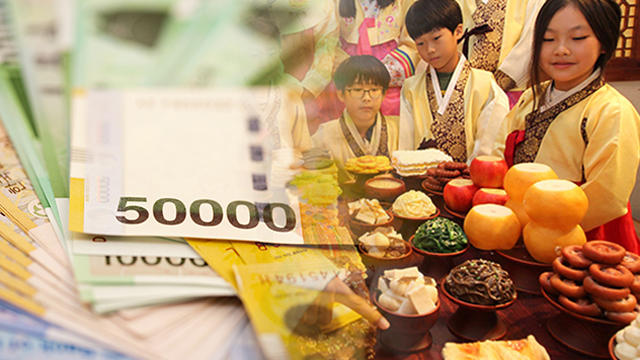 What were fun holidays as a child have become a stressful day as an adult, due in part because of my sense of obligation to give my nephews and nieces a few extra pennies. So, how much is appropriate for my nephews and nieces? There are two main schools of thought:
1-3-5-7 or 3-5-7-10. That is, start at ₩10,000 (£7) and work your way up to ₩70,000 (£48) as they age, or begin at ₩30,000 (£21) and work your way up to giving out ₩100,000 (£68). The amount given out won’t be the same for preschoolers and high school students – usually, the amount of money depends on their school stage.
First of all, there is the method of starting from ₩10,000 and going up in odd numbers to ₩30,000 and ₩50,000 won. If I were to give ₩10,000 to my nephew, who hasn’t started school yet, it would be along the ‘1-3-5-7’ principle that goes up to ₩30,000 for elementary school students, ₩50,000 for middle school students and ₩70,000 or high school students. If you think 10,000 won is a bit stingy, you could use the 2-3-5-7 method, starting from ₩20,000.
Some people argue, though, that it is appropriate to start from ₩30,000 won, considering the inflation rate. You could even start from ₩50,000 won. By starting with ₩50,000, I got more persuasive power [over my nieces and nephews].
 Analysis: one of the most popular customs (for recipients) during the autumn Chuseok festival is yongdon (용돈/用-) – when older relatives give younger family members money in red envelopes. Although Koreans usually translate the phrase as “pocket money” the word seems to signify one-off gifts at special occasions more than a weekly amount. Shops sell a variety of special envelopes, particularly around Chuseok and Seollnal, the solar new year festival in February. Typically, junior family members will make the most formal type of bow, prostrating themselves with their forehead flat against the ground in front of the senior family member, and will then be given their money. The age hierarchy in Korea means that very few people would question the convention of younger children receiving less than older ones. Korean language learners sometimes puzzle over the fact that while there are so many gender-specific words for different relatives in Korean, there’s only a single gender-neutral noun, joka (조카/侄子), to decribe both nieces and nephews. The formulation 1-3-5-7 also reflects the Korean method of counting in blocks of 만, “man”, or 10,000 – so 70,000 is expressed as “7 ten thousands.”