
17.10.2019
By Ee Seulgi
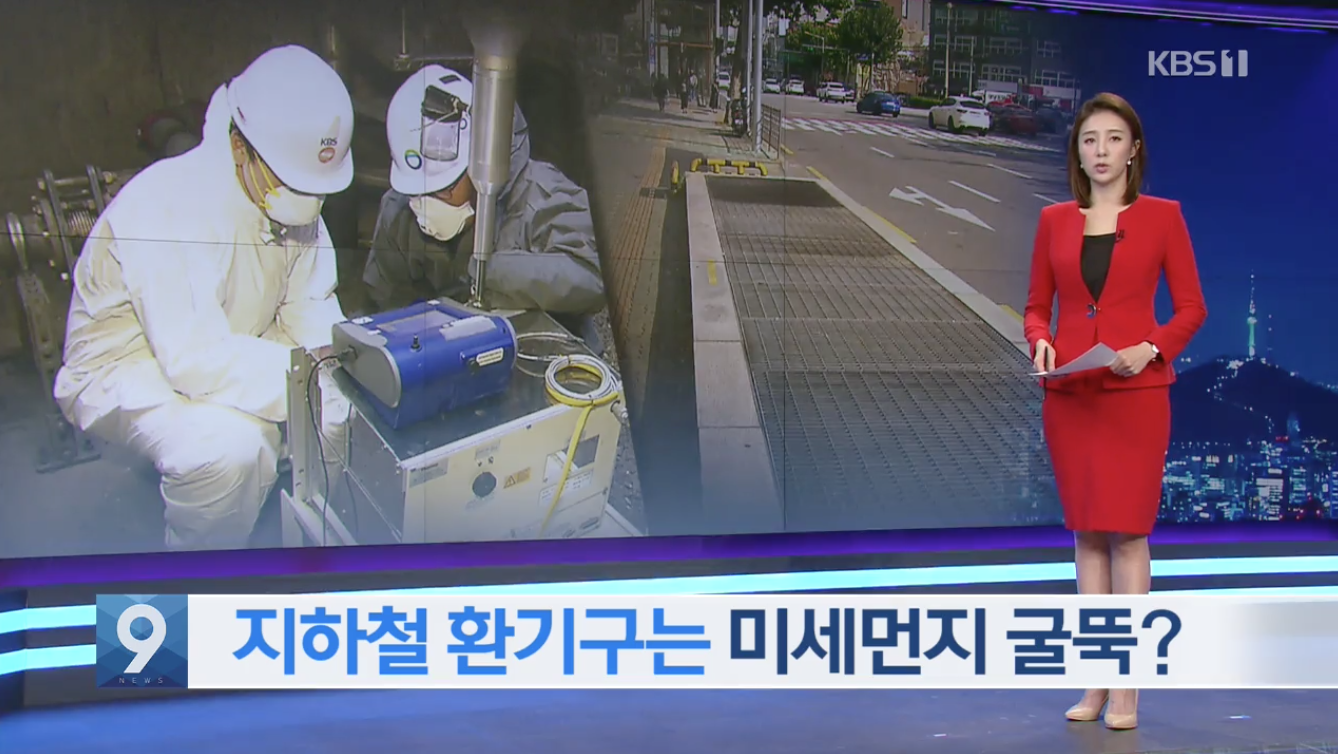
“Is the subway polluting the environment with fine dust?”
Be careful when passing by the large air vents which are often found near subway stations. This is because different types of fine dust are pumped from the lower levels to ground level through the air vents – without any filtering.
[For example] the subway vent between Pyeongchon Station and Beomgye Station on Line 4. There are children playing around the vents. What kind of air is being emitted here from the underground subway system? This reporter entered the ventilation opening, 15 metres underground, and precisely measured the fine dust concentration alongside the Environment Department.
As a result of 19 hours of continuous measurement, the average fine dust concentration exceeded 290 ㎍ per ㎥. Levels of 150 and higher are said to be very damaging to health. A Korea Environmental Protection Agency official said: “[We used] a process test method approved by the government. [Levels here] are about twice as high as levels [which would trigger] a fine dust alert.”
Especially as the train passed, the concentration soared up to 984 µg. As the tracks and train wheels wear out, they create pollutants such as metal. I opened the ventilation fan, installed in 1992. The hole in the wire mesh is hidden enough to cover the accumulated dust. Contaminated air from the train tracks travels along this vent. The exhausted air is discharged to the ground as it is [without being filtered]. There is virtually no reduction equipment such as filters. A vent is [simply] a chimney that spews harmful substances from these underground spaces to the ground.
Yu Dohee, a resident of Nowon-gu in Seoul, said: “I’m very uncomfortable when I pass [by a vent]. Hot air and dust just comes out [so I try to] avoid it.”
As a result, when the average concentration of fine dust in the outside air is 49 µg, the reading in the subway system underground is 81 and the reading on the underground tracks exceeds 178 µg. The air quality of the Jamsil and Sadang stations of Line 2 was found to be particularly poor.
Bak Jaeho, National Assembly Commissioner with the National Democratic Party, said: “No matter what measures are taken to reduce fine dust, people on the streets continue to consume fine dust from the subway vents.”
There are about 600 subway vents in the metropolitan area alone – managing pollutants so that citizens do not inadvertently inhale them while travelling is an urgent issue.