
08.09.2016
Yeonhap News/Huffington Post Korea
The number of households where people say “I live alone” has been increasing sharply. The average number of people residing in each household has reduced, attributable to a growing tendency for family members to separate [across generations].
 School textbooks traditionally showed families being composed of a grandfather and grandmother, two children and two parents; households composed of one, two or three people were rarely portrayed. But if one looks at the 2015 Housing and Population Status survey which was released by the National Statistics Office yesterday one can see that last year, the average Korean household size has decreased by 0.15 people from 2010. The average 2015 household is composed of 2.53 people while in 2010 the figure was 2.68 people. In 1990 that figure was 3.77 people; by 2005 it had fallen to 2.88 people, the first time the figure fell below an average of 3 persons per household.
Thus in 2015 single-person households made up 27.2% of the Korean population, an increase of 3.3% from the single-person household figure in 2010. At the other end of the scale households consisting of 5 people or more made up 1.2 million, or 6.4%, of the total population of Korea. The rate of single-person households has grown very quickly from the 1990 rate of 9.0% of the country’s total population. Up until 1990, the vast majority of the Korean population, nearly 60%, lived in 4- and 5-person households.
The main type of household in the country is changing.
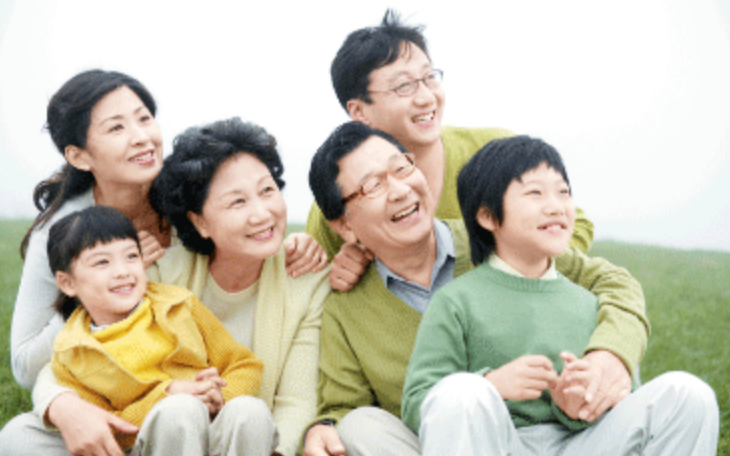
The traditional extended Korean family is becoming less common.
The area with the highest rate of single-person households is Kangwon province, in the country’s north-east, where 31.2% of households are made up of one person. Incheon comes in second, with 23.3% of households being single-occupant. People in their 30s make up the largest single group of single-person households by age, with 18.3% of the total, representing 950,000 people, while people in their 70s (17.5%/910,000) and 20s (17.0%/880,000) come in at second and third place. The gender split between male and female is very even; 49.8% of single-person households are male, 50.2% female. Registration Census Director Heo Bongchae described the results as showing that “many of the single-person households are composed of economically active females; naturally, this figure will continue to grow. Students also account for a lot of the growth in one-person households.”
Analysis: While this rather dry recap of the survey’s findings could certainly have done with some colour, it illustrates the growing problem facing mature Asian and western societies: aging, atomised populations. The particularly competitive nature of life in Korea, where there are many social and economic expectations attached to marriage and family life, serves to exacerbate this trend. As the spokesman from the National Statistics Office points out, increased female participation in the labour market has hastened the rise of single-person households in Korea. Women no longer have to rely on a a male for financial independence, and may thus find themselves delaying marriage, either because they are content to wait until they meet a partner who fulfils their expectations or because they are unwilling to shoulder the still-onerous housework and childcare obligations which many working mothers and wives are expected to shoulder. (In fairness to married Korean men, they are often automatically expected to work much longer hours than women.) Korea – and other rich countries – will have to fully engage with this reality sooner rather than later.