
03.09.2016
By Ee Seok-ho
During their summit meeting Korea’s President Bak Geun-hye and her Russian counterpart Vladimir Putin agreed that strong tactical communication was needed between the two countries to effectively deal with the North Korean nuclear issue, and that North Korea could not be allowed to become a fully-fledged nucelar power. Speaking at the Eastern Economic Forum’s opening held at Vladivostok’s Eastern Federal Region University, President Bak reiterated the need for “strong tactical communication” between the countries to tackle North Korea’s nuclear threat.
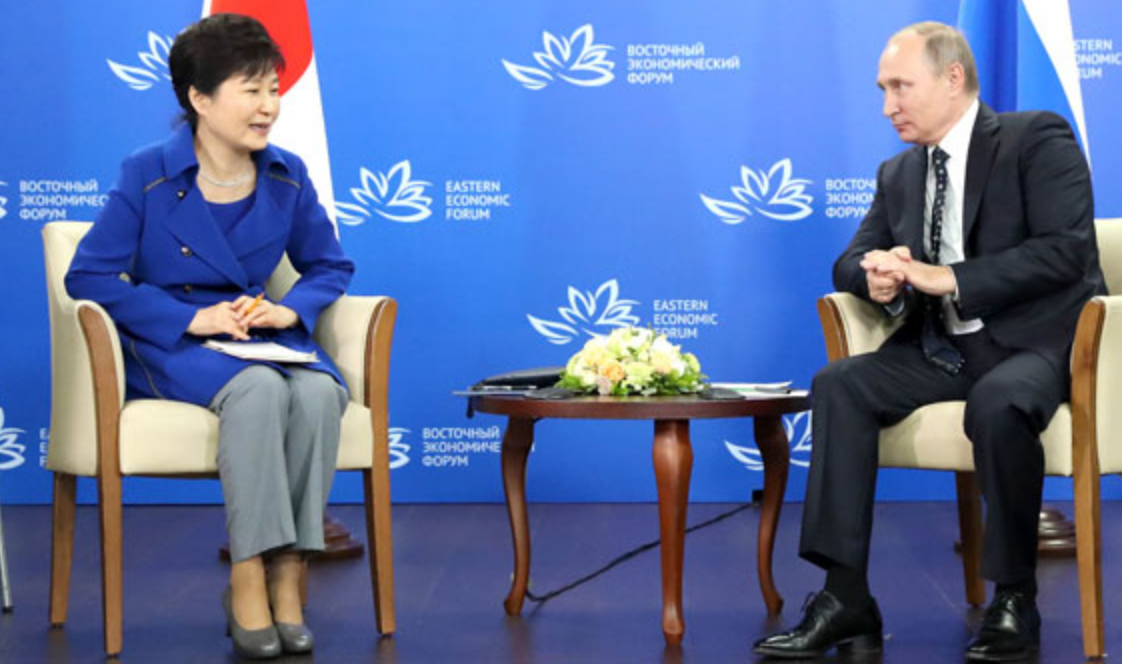 At a joint conference after the summit President Bak emphasised that “Korea and Russia are aiming for increased co-operation with each other, in order to solve the threat to security in our region posed by North Korea’s nuclear missile ambitions”. At the same press conference President Putin revealed that his preference was for no usage of nuclear weapons and that “neither of our countries will tolerate North Korea becoming a nuclear power”.
The matter of placement of THAAD launchers on the Korean peninsula was not discussed at the conference,* although it is believed that President Putin understands the importance of their usage.
*THAAD launchers would form part of an overt anti-nuclear defence system as deployed by the US and South Korea – their deployment is a sensitive issue as China and Russia don’t want to see a US-operated anti-missile system so close to their borders.
President Putin said “easing the nuclear situation on the Korean peninsula needs to be done with reference to military and political concerns” and “we should try to reduce the level of military confrontation”. It is believed that this statement may have been a reference to the THAAD issue [ie Putin is calling for THAADs not to be deployed].
President Putin “exchanged opinions on economic integration prospects and key issues in East Asia,” the Bureau for Economic Co-operation told CNN. Ways to actively attract foreign firms to Russia were also discussed.
Putin said “the Republic of Korea is an important and promising partner of Russia in this region, and we have maintained an active political dialogue between the two countries. Our traditionally close economic relations have culminated in a mutually beneficial nature.”
Analysis: This is an unusually strong statement from Vladimir Putin: his language (at least the Korean version as reported) is completely unequivocal. North Korea will not be allowed to become a nuclear power. Observers may wonder whether North Korea is already a nuclear power, and may consider that Pyeongyang’s potential attack capabilities are much more damaging for South Korea than Russia. But Bak Geun-hye’s government must be in accord with Russia to stand behind such a statement. The question is, of course, what happens when and if such strong rhetoric is put to the test. Putin and Bak are probably not the only people hoping we never find out.