Typhoon heads for Korea

30.06.2018

KBS News

BY Ee Jeonghun
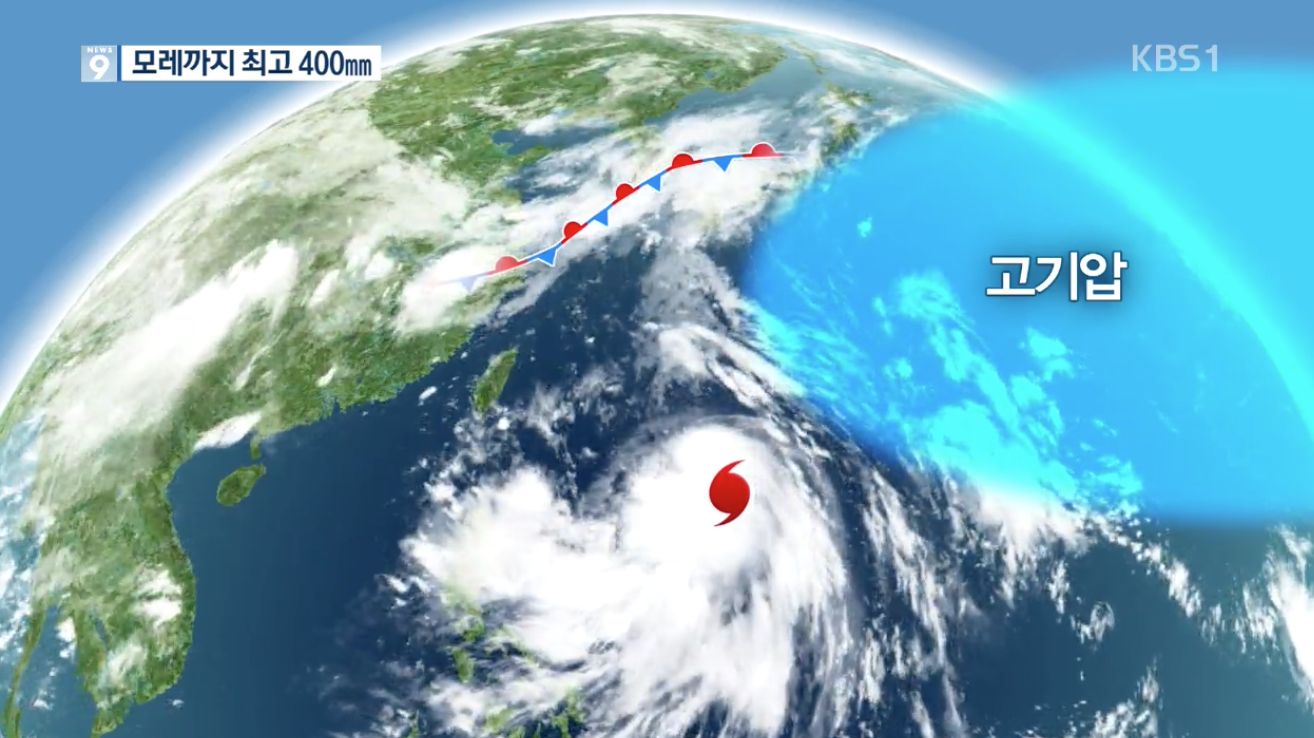
Typhoon Pprappirun is heading northwards and appears to be going to land on Jeju island the day after tomorrow (the 2nd of July). However, before that the large amount of rain it is gathering towards itself is expected to hit Seoul and the central and northern regions of the country tomorrow, early in the morning.

Reporter: Around evening time strong rains fell in Seoul and the beginnings of floodings appeared. Although Typhoon Pprappirun is still far off, a large amount of rainfall is expected. When its full front opens up, this high pressure front seasonal rainstorm will dump an extremely large amount of water. Strong, powerful rainfall is expected to hit the central and norther regions of the country tomorrow. From early morning more than 50mm of heavy rainfaill is expected in metropolitan Seoul and in the Yeongseo area of Gangwon province. Particularly narrow and strong clouds are expected to amass in this area.

Han Sangeun, a forecast analyst with the National Metereological Office, said: “tomorrow from breakast time, the central and northern regions of the country can expect strong and continuous rainfall, leading to landslides, flood damage and embankment collapses.”

The typhoon is currently moving more slowly than expected. Tomorrow the typhoon will move off the western side of Okinawa and will approach the vicinity of Okinawa. After that, there’s a large probability that it will move north along the Honam region’s west coast.

Rainfall of more than 400mm is expected above the southern coast of Korea and in the vicinity of Mount Jiri. Around 300mm is expected in the northern part of Gangwon province, and 100-250mm across the rest of the country.

Former Prime Minister Gim Jongpil passes away –figures from all spheres of public life express their condolences

KBS News

By Gim Yeongin

This morning the Seoul funeral home containing deceased former Prime Minister Gim Jongpil was crowded with mourners. Gim passed away at the age of 92 in hospital in Asan [in South Chungcheong Province, just south of the Seoul metropolitan area] at 0815 this morning amongst his family, and his departure has elicited messages of condolences from people of all walks of life. The mourning arrangements are set to be open to visitors for five days, until Wednesday next week.

Reporter: It’s now been around three hours since mourners began to file in to pay their respects to former Prime Minister Gim Jongpil. People from the worlds of politics and commerce have been arriving to express their condolences. The empty room [room where the people pay respects] has been prepared inside to the right side of the entrance. A photo of former Prime Minister Gim in his prime, dressed in a suit and smiling broadly, is mounted amongst a display of Rose-of-Sharon, Korea’s national flower. Legislator Mun Huisang from the People’s Democracy Party and Yu Seungmin from the Just Future Party, MP Bak Juseon, Korean Party member Jang Utaek and Jeong Mongjun from the Asan Foundation are among the public figures paying their respects. In a short while Chu Miae of the People’s Democracy Party and Gim Seongtae, acting President of the Korean Party, are expected to arrive. Korean President Mun Jaein, current Prime Minister Ee Nakyeon, former Defence Minister Jeong Segyun and others have called to express their regret at Mr Gim’s passing. Their messages passed on their condolences, saying that Mr Gim “had been a giant amongst Korean politics.”

The mourning arrangements are being conducted by former Prime Minister Ee Handong and former Speaker of the National Assembly Gang Changhee. The funeral is being held for 5 days, according to the deceased’s wishes. Once it is concluded the funeral procession will make its way to former Prime Minister Gim’s home.

In 2008 former Prime Minister Gim suffered a cerebral infarction. Since this month his condition had deteriorated due to old age, leading to his admission to hospital.

Analysis: this article illustrates the quite public nature of mourning in Korea – particularly when nationally-known figures pass on. People wishing to pay their condolences typically have quite a long window during which to do so; it’s an important part of the social process for a family to publically receive other mourners, and there’s also significant pressure on a grieving family to adhere to mourning conventions. The accompanying video also amply demonstrates that white is the colour of mourning in Korea. Gim Jongpil was a key figure in Bak Jeonghee’s dictatorship (1961-1979), having participated in the coup which brought Bak to power. Gim founded the notorious Korean Central Intelligence Agency, and continued playing a key role in Korean politics during the post-dictatorship phase, entering into coalition with Gim Daejung’s NCNP in the late 1990s with his United Liberal Democrats as a junior partner.

The first ever US-North Korea summit: viewpoint

KBS News

By Ee Gyeongjin

US President Donald Trump and North Korean leader Gim Jeongeun are holding a summit meeting tomorrow (10th of June), and it seems as if they might be arriving in Singapore simultaneously. The summit had been suddenly cancelled, but was re-scheduled, and it now just around the corner. North Korea’s nuclear weapons programme and continued testing of ICBM missiles will remain an issue. These issues will dominate the summit, the latest continuation in the rollercoaster ride in relations between the two countries over the last 20 years. Mike Chinoi, formerly CNN’s Asia correspondent, presented the following theory in his recent book, North Korea’s Nuclear Rollercoaster:

“As we descend towards the hair-rising spectre of open warfare and confrontation, there’s been a dramatic last-minute upward swing towards peace and reconciliation, making us release a sigh of relief.”

And so finally the very first US-North Korean summit is approaching. It’s obviously of primary importance that we see how the nuclear issue of the century unfolds between the two leaders. The question of whether or not to sit at the negotiating table with who on earth else, and with how many others, should be taken into consideration as part of the core agenda [for the summit] and any future measures. Will the talks between Trump and Gim be able to slow down the nuclear missile rollercoaster?

Analysis: a rather shallow and banal discussion of the significance of the Trump-Gim summit, this editorial makes somewhat clumsy repeated use of the phrase “rollercoaster”, which is a deeply inelegant construction in Korean.

LG Group Chairman Gu Bonmu passes away: 4th Generation Successor of Gu Gwangmo

20.05.2018

KBS News

By Yun Jiyeon

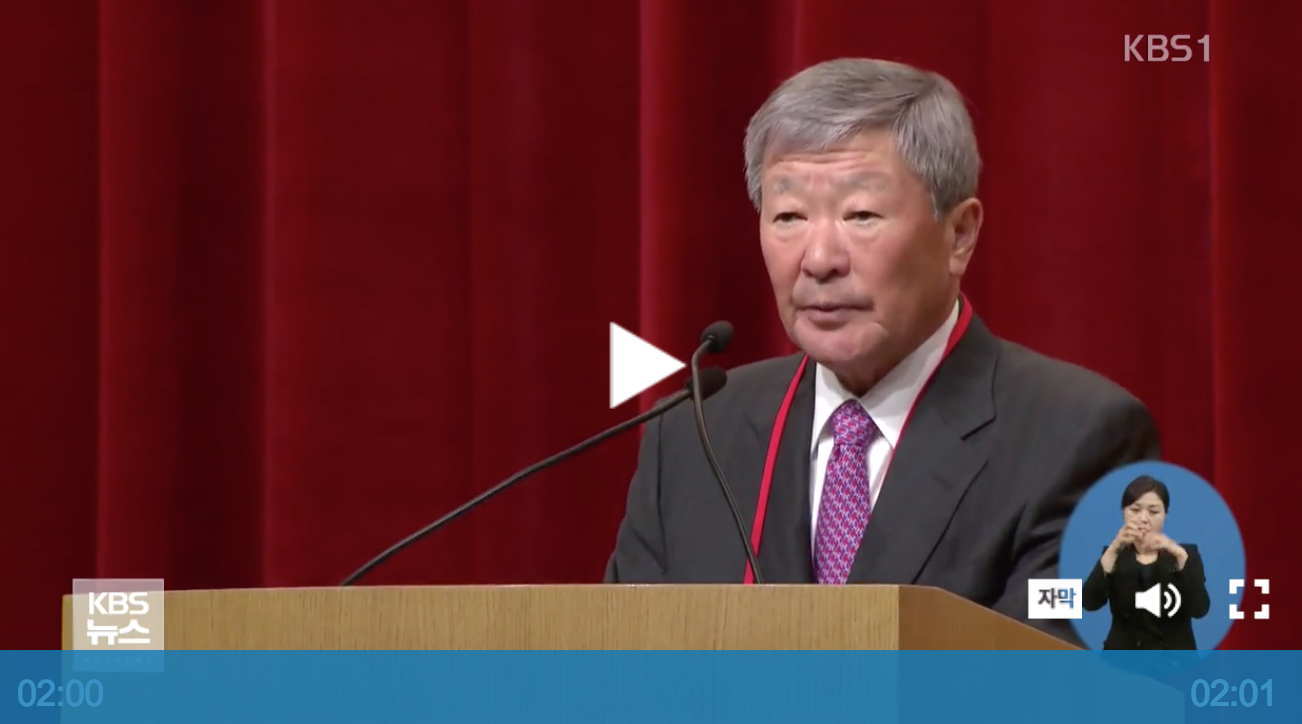
Today LG Group Chairman Gu Bonmu passed away due chronic illness. Now LG begins the task of appointing a 4th generation top executive to succeed Gu.

Gu Bonmo led the family-owned LG Group for 23 years, having followed his father, who was the group’s honorary chairman, as the company head. Gu had undergone brain surgery several times with his condition having worsened recently. Gu entered the company in 1975 and was promoted to Group Chairman in 1995. LG grew by more than five times, from ₩30 trillion at the end of 1994 to ₩160 trillion last year. In particular, overseas sales increased from ₩10 trillion to ₩110 trillion, even once the GS, LS and LIG divisions of the company had been separated.

By focusing on communications technology, displays, energy, biotechnology and so on Gu was able to create positive growth. He also took the lead in improving the company’s corporate culture by changing its name from Lucky Goldstar to LG and instigating a holding company structure.

LG has advised that Gu’s funeral will be a private family farewell, not open to the public, in accordance with the deceased’s wishes for a quiet funeral.

The procedure for appointment of a registered director of LG Group will be followed at an extraordinary shareholders’ meeting, due to be held on the 29th of next month.

Bulgogi burger suspended from McDonald’s menu after group of customers contracts gastroenteritis

2nd September 2017

KBS News

By Bak Yeonggwan

Seven primary school pupils and their children were taken ill with gastroenteritis in in North Jeolla province’s Jeonju after eating at McDonald’s. As a result of an investigation by the Health Department McDonald’s has now suspended bulgogi burgers from its menu.
Jeonju has a single McDonald’s. On the 25th of August a group of eight made up of seven primary school students and their teacher complained of stomache, diarrhea and high fever which developed into gastroenteritis. All eight of the people had eaten McDonald’s bulgogi burgers.

The father of one of the affected pupils said: “after he ate at McDonald’s he was ill for nearly 4 days and wasn’t able to eat.” This is not the first time the bulgogi burger has been caught up in such a controversy. In July a four-year-old child caught the so-called “hamburger illness”, also known as hemolytic uremic syndrome. Their family sued McDonald’s. In addition, the Korean Consumer Agency reported that it had detected more than three times the normal amount of staphylococcus aureus bacteria in a bulgogi burger which it tested at the beginning of last month. McDonald’s has now stopped selling bulgogi burgers at all of its locations throughout the country.

Jang Goun, McDonald’s Public Relations Team Leader, said: “We have decided to discontinue sales of the product until the investigation results show [they are safe]. It is a preemptive measure for customer safety.”

Analysis: One might wonder why a case of food poisoning is front-page news, but for whatever reason gastroenteritis holds a very prominent place in the Korean cultural psyche. The McDonald’s bulgogi burger is based on Korean bulgogi (“fire meat”) and is marinated in a very tasty, slightly sweet barbeque sauce. It doesn’t necessarily mesh that well with cheese but is certainly one of the better localised McDonald’s offerings I’ve come across. Of course, whether its reputation has now been irreperably damaged in its homeland remains to be seen. Certainly some Koreans don’t feel very well-disposed towards American businesses; this story may reinforce some of their resentmen. There’s also a strong tradition of seniors taking juniors for meals which includes teachers taking students out for meals in a way which is completely absent from the UK.

President promises job creation will be a priority

4th June 2017

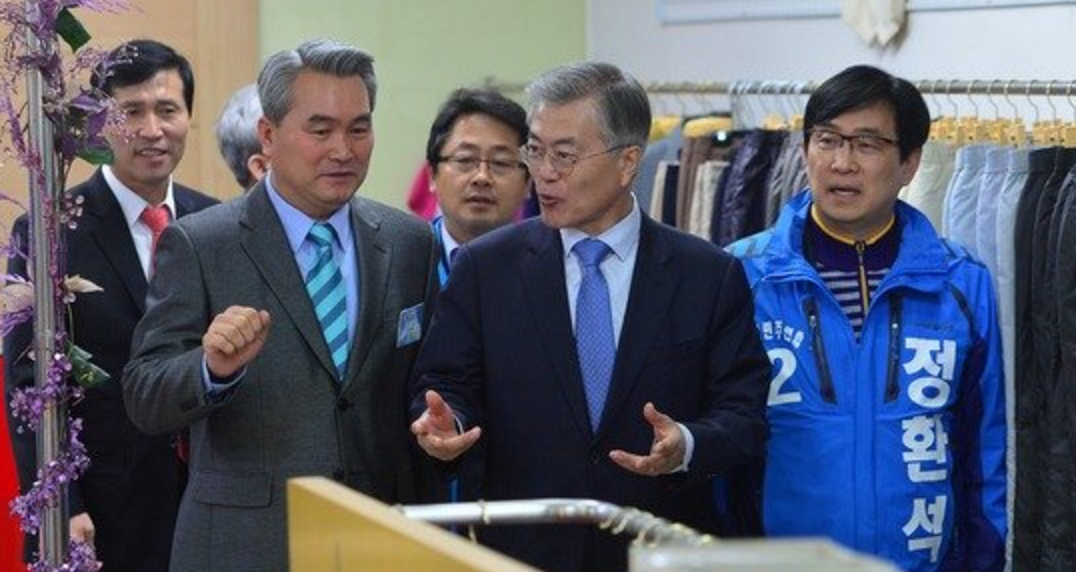
President Mun discusses his “1 won” budget on a visit to a workplace

The Blue House said that it will be investing heavily in job creation for those who are on low incomes and are facing immediate difficulties. President Mun Jaein expressed his strong will to solve employment issues by creating jobs, and said that his new “1 won” budget will act to stimulate employment. Earners’ incomes have been steadily decreasing over the past year, the Blue House continued, and job shortages and worsening income distribution are only making the situation worse. Jang Haeseong, the Blue House Chief of Policy, said “I think it is important that the government introduces these measures in a timely fashion. A lot of people have lost jobs and have lost their income.”

President Mun plans to increase the number of jobs available by releasing a stimulus package of ₩200 billion, saying that “I will ensure that even a 1-won national budget will surely lead to a job” in a message greeting visitors to the Jobs Commission homepage. The government plans to submit details of its job creation proposal tomorrow (5th of June), which will then be brought to the National Assembly on the 7th.

Analysis: while North Korea’s maneouverings continue to capture international attention, President Mun’s statement highlights that the South Korean economy is the most pressing issue for South Koreans. Elected as a counter to the perceived cronyism and concern for big business of the Bak Geunhye regime, President Mun is now eager to ensure that the electorate sees his policies as oriented towards ordinary working people. Expect his unabashedly populist rhetoric to continue.

KTX passenger tells rail employee: “I don’t like the way you check tickets”

01.05.2017

KBS News – video at link

By Gim Gyeae

While assaults on aircraft crew have been an issue for some time now, there has now been an incident where a passenger assaulted a crew member on the KTX high speed train as it was running. The reason: the passenger didn’t like the way the crew member checked his ticket.

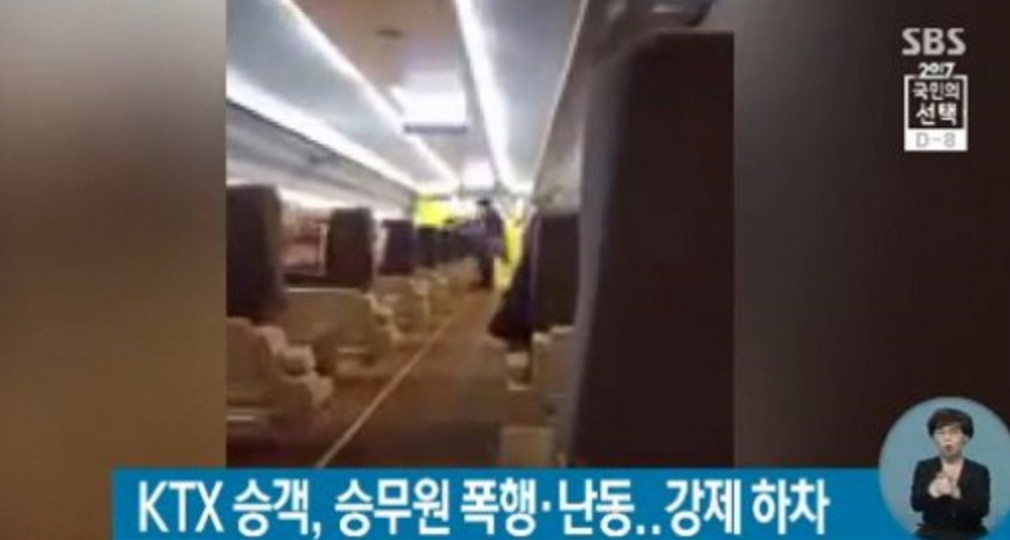
Today at 06:10, inside a KTX leaving Busan bound for Seoul, a man suddenly shakes his fist and strikes his opponent. He even kicked [the victim] once he’d fallen over. The victim is a KTX crew member. The passenger had bought an economy class ticket but was travelling in a first-class carriage, and the incident occurred when the staff member asked him to present his ticket. A colleague of the assaulted crew member said: “We have a machine which checks ticket. The man’s seat should have been empty – as soon as my colleague asked to check his ticket he became violent.” Korail immediately informed its incident room about the case, and 20 minutes later when the train came to the next stop in Ulsan special law enforcement police arrested a 37-year-old man, a Mr Jo. Mr Jo stated that he had been enraged by the crew member’s request to confirm his ticket. He will be indicted on suspicion of violating the railway safety law. The 38-year-old victim Mr Nam has been taken to Seoul Station and treated at the hospital emergency room.

Analysis: Social interactions in Korea are governed by a very complex set of linguistic and cultural expectations – it’s possible this rather unpleasant customer was triggered by what he thought of as overly blunt language from the KTX employee. Koreans expect deference from staff when they’re paying customers and it’s common to witness quite rude treatment of employees. However, public random violence is rare enough for this type of incident to make national headlines. This incident comes in the context of recent high-profile incidents in Korea and elsewhere of violent behaviour by staff and passengers on airlines.

Secret history of the Bali comfort women

17.04.2017

KBS News

By Ee Seungcheol

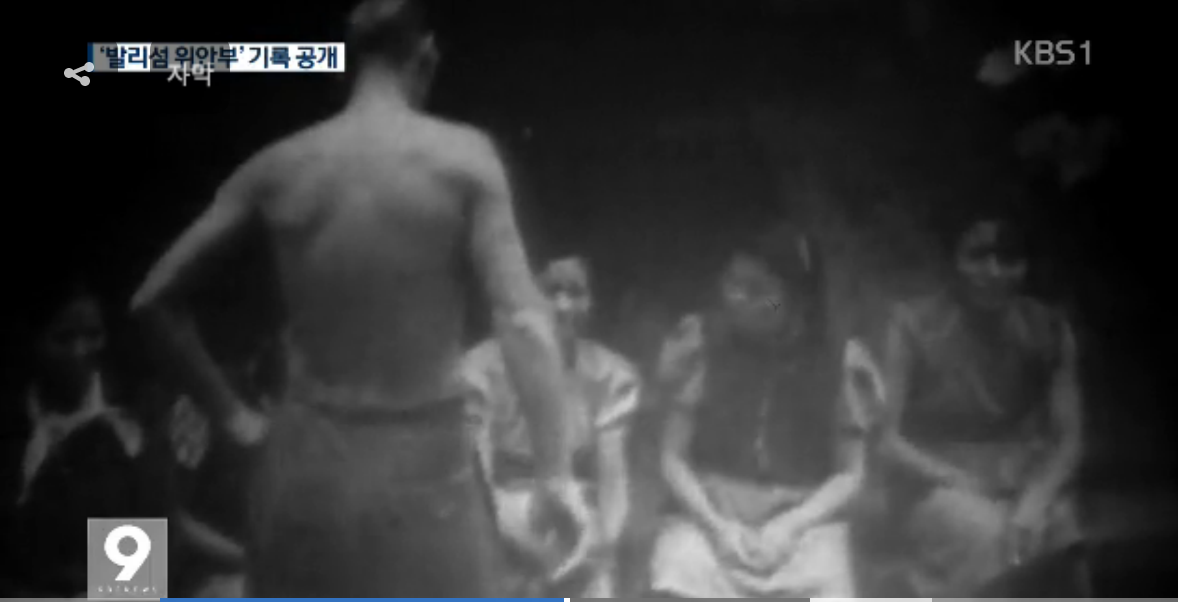
The Japanese military has revealed that hundreds of women were taken to work as “comfort women” on the island of Bali, Indonesia during the Pacific War [World War 2]. Although the Japanese government has kept this information hidden for decades, [it still] denies that these women were forcibly enslaved. The Japanese Ministry of Justice questioned a Japanese naval military prosecutor who was punished as a Pacific war criminal in 1962 [to discover this issue]. The most chilling aspect of the story is that it is a “comfort women” issue; the disgraced prosecutor said “during four years of the war, we brought around 200 women to work as ‘comfort women’ in Bali.”

It was also revealed that the Japanese military had spent about 700,000 yen in military funds after the war concealing this issue. The prosecutor was [subsequently] charged as a war criminal, but denied being involved in comfort women activities. His testimony is key evidence that that the Japanese military systematically mobilised comfort women – then intervened to conceal their activities after the war. Professor Hayashi of Japan’s Ganto University said “the Japanese government is claiming that it didn’t undertake any illegal activities, but clearly the soldier who undertook this cover-up was aware of that fact that these undertakings were illegal.” The Japanese government has classified the data for more than 50 years and classified it as confidential in February. As Japan’s Prime Minister Shinzo Abe said in January: “among the data we haven’t found anything which points to forced mobilisation.” The Japanese government has not yet recognized more than 400 articles on comfort women, including military trial records, as official documents.

North Korea’s long-distance missile factory

19.03.2017

KBS News

Video at link

By Choi Yeongyun

North Korea has made a new engine for use in long-distance inter-continental nuclear missiles. They’ve been parading their developing skill in producing auxiliary engines even more. Having developed two missiles which can now reach the US mainland, they have now arrived one further stage along in their development [of missiles].

A jet of flame flares out from the missile. North Korea has developed this all itself, and is now testing this latest high-powered engine. As the North’s own Joseon Central TV said: “We have produced a large-output-type mover that has a higher propulsion speed than that of the previous engine.” This most recent test was believed to have progressed similarly to the test which took place in September. While a large flare could be seen coming out of the missile during the first test, only a small red-coloured flame was witnessed during this test. Four auxiliary engines were added to the main event.

Our analysis is that the new missile’s guidance system means that its flight and stability is higher than before. The turbine pump it uses also adds liquid fuel to the missile’s. Shin Jongu, manager of the Korean Security Forum, said: “this test is to show Gim Jeongeun the results of the auxiliary engine, which is the last step for mounting a missile on the ICBM.”

A fired-up Gim Jeongeun has been motivating his scientists and engineers. As Joseon Central TV reported, “Our esteemed Supreme Leader Comrade Gim Jeongeun expressed great satisfaction about the progress of the new type output engine.”

While up to this point Pyeongyang had been stubbornly referring to its “large footprint engine” as [merely] a “satellite”, now it has been referring to it as a “new type of weapon development project”, not hiding that it is part of a long-range missile development project.

Populism | Constitution | The Third Party: what are the variables in the presidential election?

KBS News

Video at link

By Shin Jihae

Among the surprises and shocks thrown up by the political situation around the early election, from political circles are sprouting many various factors, which if they become real, would seem to be influencing each party to take on an ideological idea as their slogan. Here we examine the factors that inluence the so-called large-scale theory, the constitutional revision, and a third party.

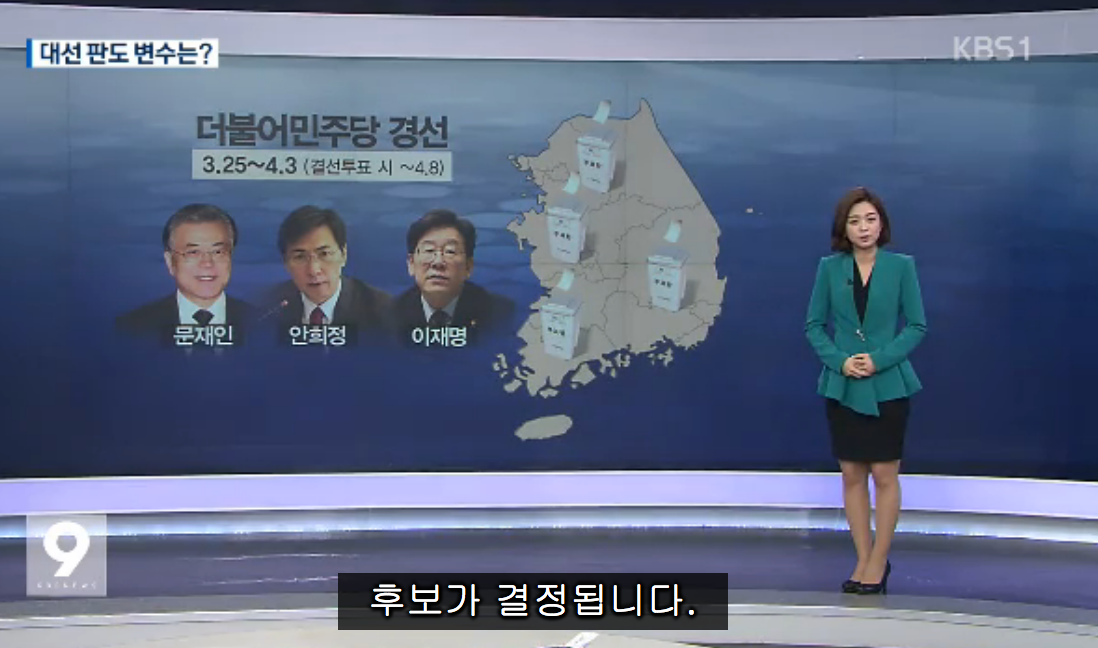
With an unprecedented early election, the result of the [opposition] Democratic Party’s primary election is of supreme interest [to the public]. Starting from Honam on the 25th, the candidates will be selected through Chungcheong, Yeongnam and the metropolitan area in succession. If the candidate Mun Jaein wins a big victory in the first race it is likely that he will build an unattainable lead. However if Ahn Heejeong received a surprise nomination, the contest may change. Analysts are undecided as to whether the success of No Muhyeon from 2002 [who won the first round of the nominations easily and went on to take nomination for the Democratic Party before going on to win the election] will be repeated.

Unification behind the conservative candidate is also key. Yu Seongmin insists on unifying the candidates, but Nam Gyeongpil, the governor of Gyeonggi province, said that he would not follow the party line. Meanwhile there has been no confirmation yet of expected candidates like Hong Junpyo and Gim Gwanyong, possibly due to a lack of unity behind candidates.

Analysts believe that a third party candidate could potentially mount a strong challenge the established parties if they do not unify strongly behind their nominations.