President Bak openly says to the North Korean people: “Come towards South Korean-style freedom”

1st October 2016

Yeonhap News via Huffington Post Korea
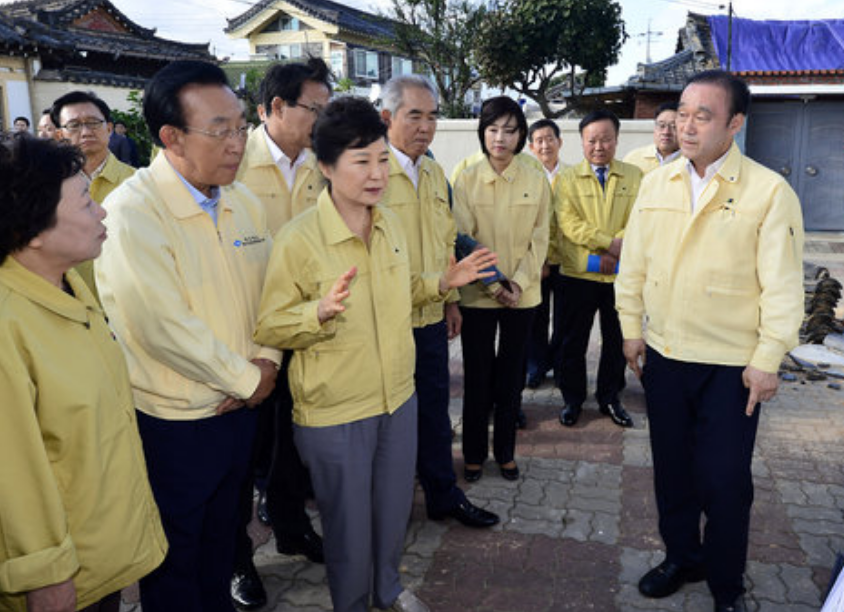
Bak Geunhye addresses the press in Chungnam, 1st of October

Bak Geunhye addresses the press in Chungnam, 1st of October

Today South Korean President Bak Geunhye said “the North Korean leadership is testing our will, meanwhile its society is collapsing due to internal struggle. Now their interior division and chaos is aggravating our fears around North Korean nukes.*” Speaking at the 68th anniversary celebrations of the founding of the Korean army in Chungnam, the President said “while our country remains united and our military remains as one, we will tear down the false delusions of the North Korean leadership and our national society will unite as one with strength.”

“Whatever attacks are made, it’s certain that South Korea and us, its people, will survive together, and whatever this government [ie North Korea] tries the North Korean threat will not be yielded to. The will of the South Korean people will certainly need to be strong. Whatever differences there are between our ideologies and factions, I entreat all [South] Koreans to remain united along the same path,” she underlined.

The President commented that North Korean leader Gim Jeongeun “is showing off his nuclear missile capability, thereby heightening military tensions, in an attempt to stabilise his country’s internal conditions, but this [tactic] is a delusion and a misjudgement.” Bak went on to warn that “If North Korea will not give up the so-called ‘nukes for economic advancement’ route, its international isolation and economic problems and will become more serious as time goes by, leading to the failure of its system and more internal unrest.”

The President emphasised that “those who come late to deal with the crisis will be punished in the assessment of historians. Even at this stage, North Korea could turn away from its nuclear weapons and face the reality of its situation, and return to being a normal state.” Addressing the North Korean military and citizens, Bak said “we know only too well the terrible reality you are facing. As a nation we understand the human rights abuses which the North Korean leadership commits.” She pointed out that “it’s your right to enjoy universal values like democracy and freedom, human rights and welfare.”

This marks the first time that President Bak has openly implored the North Korean people to move towards South Korean values.

Analysis: As the article notes, this is particularly strong rhetoric from President Bak, who has never made such clear denunciations of North Korea in the past. Her remarks are intended primarily for domestic consumption; ordinary South Koreans have grown tired of the constant stream of violent invective from Pyeongyang and want to hear their President fight back. The number of ordinary North Koreans who will hear Bak’s exhortations will be effectively nil, although Gim Jeongeun’s government will certainly be listening, and will almost certainly respond with continued threats. One has to hope that the North Korean administration remains rational, whatever they threaten.

*Bak used the word 핵 (“haek”) to describe the North’s nuclear weapons – literally “nuke”, a notably informal word for this context.

Earthquake damage to property 20 times higher than originally estimated – total cost set to reach ‎₩4 billion

September 18th 2016

KBS News

By Im Jongbin

Video at link

Damage to historically significant buildings

Damage to historically significant buildings

The earthquake made tiles come off the roof, which are now scattered here and there. The earthquake occurred six days ago now, but recovery is far from complete. Temporary tents have been erected [around the damaged buildings] to prevent water leaking into them.

Ee Chunhee (resident of Sajeong-dong in Gyeongju) said “natural disasters can’t be helped, but that fact that we have to make repairs yet again makes me worry about the future [because of the cost involved].” Immediately after the earthquake, the number of cultural properties which have been damaged increased from 23 cases to 60 cases. There are around 300 plastic tents covering varying public facilities [across the city], but only around half of them have first aid facilities. At the epicenter of the quake on the 14th damage injured anything from 29 to 48 people. As a result the government has authorised a special emergency grant of ‎₩4 billion to be sent to affected areas tomorrow to support emergency recovery. The disaster relief fund payments can be disbursed promptly from tomorrow as the [official] investigation into the incident is set to wrap up.

Analysis: while the nuclear diplomacy situation on the Korean peninsula remains extremely tense and garners the lion’s share of international media coverage, the earthquake which occurred in Gyeongju in North Gyeongsang province this week is still high on the domestic news agenda. Gyeongju is a site of enormous cultural and historic significance, where many houses are built in the traditional hanok style, and there are numerous museums housing extremely valuable artefacts. Koreans were extremely concerned about the earthquake as the country has been relatively tectonically stable in recent years, and the fact that the historical centre of Gyeongju was at its epicenter added significantly to their worries.

“I live alone” is now becoming a trend: the number of 1-person households has reached over 5.2 million

08.09.2016

Yeonhap News/Huffington Post Korea

The number of households where people say “I live alone” has been increasing sharply. The average number of people residing in each household has reduced, attributable to a growing tendency for family members to separate [across generations].

Screen Shot 2016-09-07 at 21.56.40School textbooks traditionally showed families being composed of a grandfather and grandmother, two children and two parents; households composed of one, two or three people were rarely portrayed. But if one looks at the 2015 Housing and Population Status survey which was released by the National Statistics Office yesterday one can see that last year, the average Korean household size has decreased by 0.15 people from 2010. The average 2015 household is composed of 2.53 people while in 2010 the figure was 2.68 people. In 1990 that figure was 3.77 people; by 2005 it had fallen to 2.88 people, the first time the figure fell below an average of 3 persons per household.

Thus in 2015 single-person households made up 27.2% of the Korean population, an increase of 3.3% from the single-person household figure in 2010. At the other end of the scale households consisting of 5 people or more made up 1.2 million, or 6.4%, of the total population of Korea. The rate of single-person households has grown very quickly from the 1990 rate of 9.0% of the country’s total population. Up until 1990, the vast majority of the Korean population, nearly 60%, lived in 4- and 5-person households.

The main type of household in the country is changing.

Screen Shot 2016-09-07 at 21.58.07

The traditional extended Korean family is becoming less common.

The area with the highest rate of single-person households is Kangwon province, in the country’s north-east, where 31.2% of households are made up of one person. Incheon comes in second, with 23.3% of households being single-occupant. People in their 30s make up the largest single group of single-person households by age, with 18.3% of the total, representing 950,000 people, while people in their 70s (17.5%/910,000) and 20s (17.0%/880,000) come in at second and third place. The gender split between male and female is very even; 49.8% of single-person households are male, 50.2% female. Registration Census Director Heo Bongchae described the results as showing that “many of the single-person households are composed of economically active females; naturally, this figure will continue to grow. Students also account for a lot of the growth in one-person households.”

Analysis: While this rather dry recap of the survey’s findings could certainly have done with some colour, it illustrates the growing problem facing mature Asian and western societies: aging, atomised populations. The particularly competitive nature of life in Korea, where there are many social and economic expectations attached to marriage and family life, serves to exacerbate this trend. As the spokesman from the National Statistics Office points out, increased female participation in the labour market has hastened the rise of single-person households in Korea. Women no longer have to rely on a a male for financial independence, and may thus find themselves delaying marriage, either because they are content to wait until they meet a partner who fulfils their expectations or because they are unwilling to shoulder the still-onerous housework and childcare obligations which many working mothers and wives are expected to shoulder. (In fairness to married Korean men, they are often automatically expected to work much longer hours than women.) Korea – and other rich countries – will have to fully engage with this reality sooner rather than later.

Korea-Russia summit: “To find a solution to North Korea’s nuclear activities we need strong tactical communication”

03.09.2016

KBS News

By Ee Seok-ho

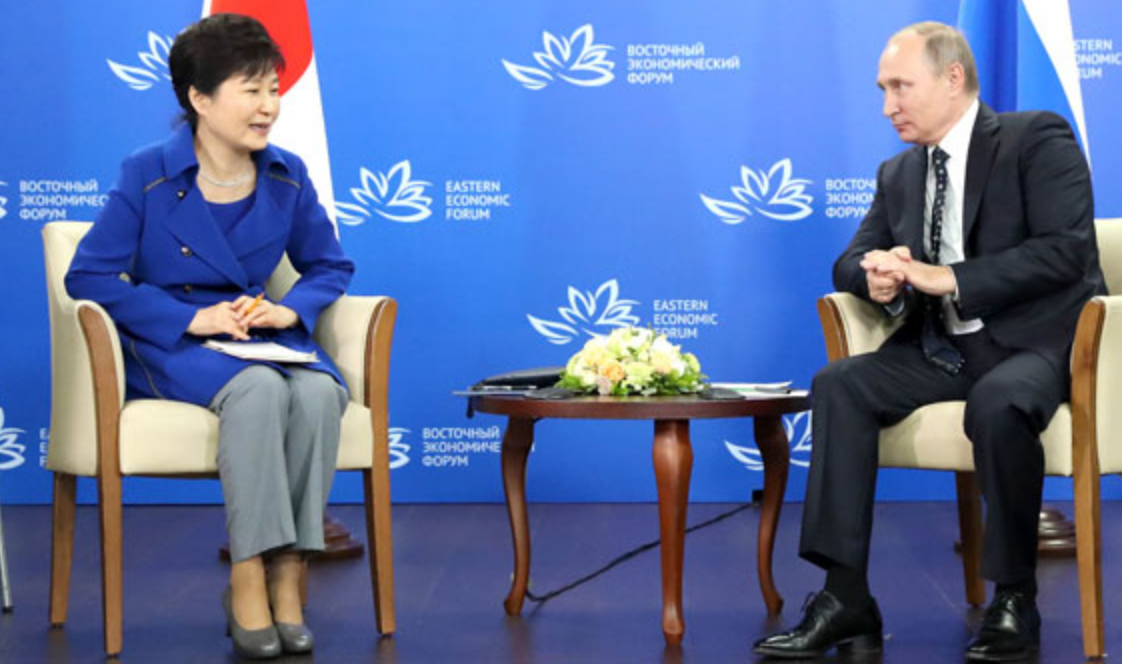
During their summit meeting Korea’s President Bak Geun-hye and her Russian counterpart Vladimir Putin agreed that strong tactical communication was needed between the two countries to effectively deal with the North Korean nuclear issue, and that North Korea could not be allowed to become a fully-fledged nucelar power. Speaking at the Eastern Economic Forum’s opening held at Vladivostok’s Eastern Federal Region University, President Bak reiterated the need for “strong tactical communication” between the countries to tackle North Korea’s nuclear threat.

Screen Shot 2016-09-03 at 16.08.07At a joint conference after the summit President Bak emphasised that “Korea and Russia are aiming for increased co-operation with each other, in order to solve the threat to security in our region posed by North Korea’s nuclear missile ambitions”. At the same press conference President Putin revealed that his preference was for no usage of nuclear weapons and that “neither of our countries will tolerate North Korea becoming a nuclear power”.

The matter of placement of THAAD launchers on the Korean peninsula was not discussed at the conference,* although it is believed that President Putin understands the importance of their usage.

*THAAD launchers would form part of an overt anti-nuclear defence system as deployed by the US and South Korea – their deployment is a sensitive issue as China and Russia don’t want to see a US-operated anti-missile system so close to their borders.

President Putin said “easing the nuclear situation on the Korean peninsula needs to be done with reference to military and political concerns” and “we should try to reduce the level of military confrontation”. It is believed that this statement may have been a reference to the THAAD issue [ie Putin is calling for THAADs not to be deployed].

President Putin “exchanged opinions on economic integration prospects and key issues in East Asia,” the Bureau for Economic Co-operation told CNN. Ways to actively attract foreign firms to Russia were also discussed.

Putin said “the Republic of Korea is an important and promising partner of Russia in this region, and we have maintained an active political dialogue between the two countries. Our traditionally close economic relations have culminated in a mutually beneficial nature.”

Analysis: This is an unusually strong statement from Vladimir Putin: his language (at least the Korean version as reported) is completely unequivocal. North Korea will not be allowed to become a nuclear power. Observers may wonder whether North Korea is already a nuclear power, and may consider that Pyeongyang’s potential attack capabilities are much more damaging for South Korea than Russia. But Bak Geun-hye’s government must be in accord with Russia to stand behind such a statement. The question is, of course, what happens when and if such strong rhetoric is put to the test. Putin and Bak are probably not the only people hoping we never find out.

School violence rate decreases – but students are finding non-physical bullying more hurtful than ever

22.08.2016

Huffington Post via Yeonhap News

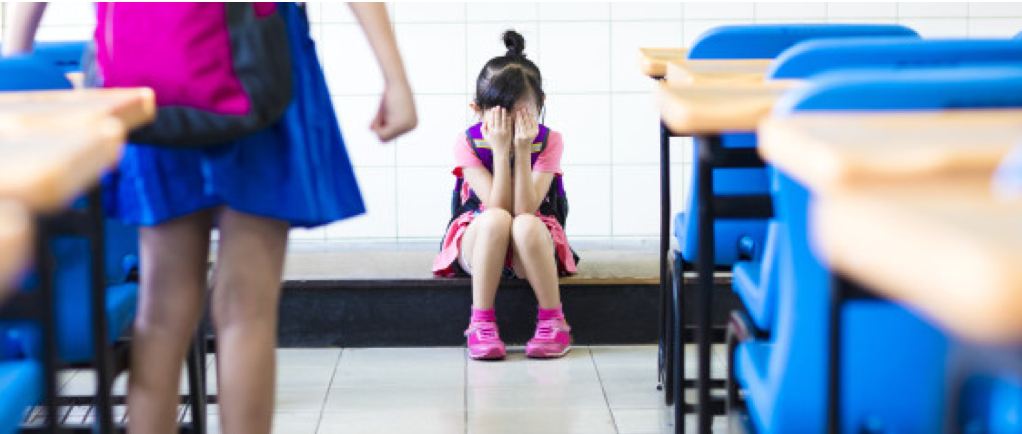
While [a new survey has found that] physical violence in schools appears to be declining, students are more likely these days to be severely emotionally affected by other types of bullying. School violence rates were highest in Busan this year, analysis of the survey’s results reveals, as [across the country] 117 reporting centres recived 2,089 reported cases of school violence. 39.4% of the total, 824 cases, involved serious violence or intimidation. Comparing the figures to the previous year reveals that these serious cases have declined by 7.5%, while bullying and harassment cases fell by 1.4% and sexual harassment cases fell by 0.7% to make up 3.1% of reported totals. In contrast, cases of insulting [speech] were up 34.5% from the previous year. A police source said that these cases were typically arguments between friends which developed into something more severe involving profanity.

Overall, priScreen Shot 2016-08-21 at 17.34.25mary school pupils were the most likely to have experienced violence, making up 59% of respondees who had been exposed to violent behaviour. Junior secondary school children made up 20.5% of repsondents who had experienced violence, and high school students made up 11.9% of respondents who had been the victims of violence.

38 cases required a formal police response; [nationwide] 363 police officers specialise in school violence crimes. “Thanks to educational campaigns, we have seen a large reduction in school violence,” a police spokesperson said. “We’re seeing a lot less intimidation of students. However, [as usage of insulting/contemptuos words is rising], we must be aware that insulting words can cause wounds to the psyche which may not heal easily.”

Analysis: Korea has an extremely complex relationship with violence in schools. As a strictly hierarchical society, very few people question the use of corporal punishment by teachers in schools, although in some provinces (notably Gyeonggido, which surrounds Seoul) its usage is formally banned. The Korean cultural requirement for absolute obedience to one’s elders (at least in theory) also means that bullying of younger pupils by older children is a persistent issue. (The term hakkyo pokryeok, “school violence”, is a media buzzword used to describe all types of school-based harassment and bullying, not just physical violence.) In recent years there’s been real will at all levels of Korean society to move away from the often brutal character of education, but certain of Korea’s specific cultural traits makes it challenging for these initiatives to fully succeed.

“My face is unfamiliar”: secret selfie addiction

KBS News

6th April 2016

Video at link

Screen Shot 2016-04-06 at 1.46.08 PM

(left): Appearance as seen; (right) appearance via selfie

Spring flowers are blooming here in Yeouido [in Seoul], and people are using selfie* sticks to capture photos. But why do some people use exactly the same pose in all of their photos? Because throughout our life we see ourselves in the mirror with right and left swapped, when we actually see ourselves as we appear via photographs, it can be an uncomfortable experience. So, we continue taking selfies until we can find one which guarantees [that we look the way we think we do]. More and more people are trying to take that “special” selfie. By putting the information from 100 photos into a 3D printer, a fully 3D impression of a selfie can be made. Also recently appearing and rapidly gaining popularity is a “selfie drone”, which flies in mid-air and follows its subject around to capture selfies from every angle.

It’s a natural instinct for people to be interested in their own faces. Perceiving the outside world through our own eye sight stimulates the brain’s, but it’s only the face which activates the frontal lobe, responsible for feelings. If we compare someone else’s face to our own, the comparison makes more “sense”.

Gim Gyeongil, a Psychology professor at Aju University described the process: “when people see their own faces, people’s reactions, namely their emotional reactions, are maximised. This is actually how we are designed as humans.” At the same time, a selfie can express how a person relates to themselves. Because of this, some people don’t hesitate to take too many [selfies]. Added to that, we’re now living in a time where there’s a craze for people to constantly share their photos on social media.

Analysis: Korea is an intensely image-focused society, and it’s no surprise to see media coverage of the pressure people feel to present a perfect version of themselves via photographs. It’s very common for Koreans to have passport photographs and job application photos digitally retouched (and it’s telling in itself that jobs often require a photograph of applicants); Korea is also a world-leading market for plastic surgery. I don’t believe that selfie drones are becoming massively popular, and this piece also contains some pretty questionable assertions, but there’s no denying the primacy of physical attractiveness in Korea. I was shocked to see mirrors in every single classroom while teaching there – and lots of female students (and a few males) habitually carry small hand mirrors.

*”Selfies” are called “selka” (셀카) in Korean – a contraction of the English words “self” and “camera”. I heard this phrase when I arrived in Korea in summer 2008, a few years before I heard the word “selfie” in English.

Electoral Poll Forecasts Tight Race

29.03.2016

KBS News

Electoral Poll Results

Since the 23rd of March members of the press in the Seoul region were surveyed. If one looks at the main points, it seems that respondents feel that the race will be especially tight in the capital’s areas of Nowon, Guro and Yongsan. Shall we look at the relevant points for the lead characters in the 16 different areas of Seoul?

Saenuri [New World] leads in 6 regions. NPAD [New Politics Alliance for Democracy] leads in 2 areas. The remaining eight places are currently too close to forecast. One factor will influence the way the election in Seoul drifts; in Incheon in Gyeonggi province, among the 11 areas of questioning of the survey, more than half of the margin of error was within six regions forecast as a tight race.

In Yeongnam I looked at 16 districts. 4 of those returned survey results within the margin of error [ie, extremely close]. Among four other areas, Saenuri or independent candidates are set to grab 3rd place while fighting these close contests. Where independent candidates are currently forecast as being in 1st place there are significant independent variables.

Research done in the Honam region has opposition NDAP candidates ahead in two out of seven areas, with the People’s Party forecast to win three wards, with a tight struggle forecast. In Gangwon’s eight areas, according to the results of the survey Saenuri are due to win 6 areas while the other two are forecast to be very tight struggles.

The entire outcome of the election seems to depend on who will best engage with regions forecasting tight struggles.

His Name Still Burns: An Junggeun

Chosun Ilbo

25.03.2016

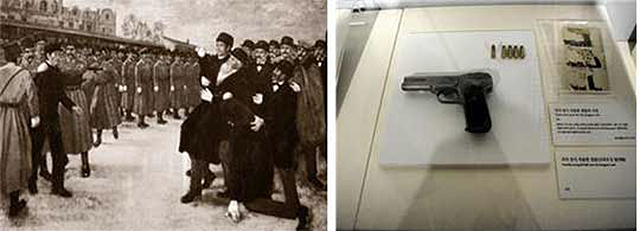
2016031702469_0On the 26th of March it will be 106 years since the death of the martyr An Jeunggeun. An once said “when our national sovereignty is restored, the harm to our homeland will be buried”, but the sovereignty of his homeland has still not been restored. This latter quotation was enscribed on his tombstone and he is remembered annually in ceremonies, and it’s important that everyone knows his sentiment.

His last words just before he lost his life for his country:

“In order to restore Korean independence and maintain peace between East and West overseas, for the last three years I have been living without a home. I was not able to achieve my goal so now I must die. There are 20 million of us brethren, all striving to promote education and commerce; if you follow my cause, you will not stop even at death until our freedom and independence has been restored.”

Through his Samheung school An worked hard to raise up competent independence activists. In Harbin in Manchuria he assassinated the main architect of the [Japanese] invasion, Ito Hirobumi. After his death he was [eventually] honoured with the National Order of Grand Merit by the Republic of Korea.

2016031702469_3

Assassination of Ito Hirobumi on Harbin station (l); the gun used in the incident (r)

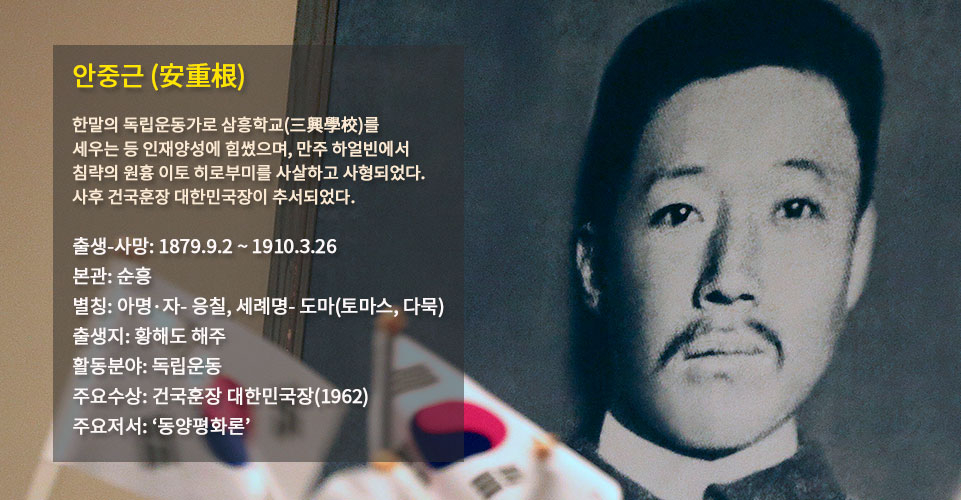
An Junggeun

02.09.1879 – 26.03.1910

Clan hometown: Sunheung

Alias: Amyeong

Pen name: Eungchil

Baptism name: Tomas

Birthplace: Haeju in Hwanghaedo

Known for: Independence activism

Honours awarded: Korean Grand Order of Merit (1962)

Main literary work: Treatise on Peace for East and West

Timeline

1879     Born on the 2nd of September in Haeju, Hwanghaedo

1895     Enters the Catholic church, encouraged by his grandfather

1904     Travelled alone to Pyeongyang, stowing away via coal train

1906     After the 1905 Treaty of Eulsa between Japan and Korea, which made Korea a Japanese protectorate, An sold his school, Samheung

1907     Took part in “righteous band” guerilla activity against Japan in the Maritime Province of Siberia

1909     Assassinated Ito Hirobumi

1910     Executed on the 26th of March 1910

Early life

From a Sungheung clan and born in Hwanghae, An was born with seven marks on his chest and stomach as if he had been branded in accordance with the Big Dipper. Growing up, the marks were thought of as representing a letter. His grandfather and his father, An Taehun, both served as officials who had only passed the first level of the bureaucratic examination process. His grandfather earned wealth through selling rice. An Junggeun learned about Korea from a very young age, although he was more interested in martial arts as a child. He was a skilled hunter and horse rider, and was known as Sharpshooter, even amongst other hunters. When the Donghak movement arose in 1895, his father An Taehun was involved in organising soliders to quell the Donghak troops. With his father’s encouragement in 1895 he began learning new academic ideas, including speaking French, under Catholic priests. He also got a Catholic name, Tomas.

Righteous Band Activities

In 1904 he began working in the coal industry in Pyeongyang; in the following year when the Treaty of Eulsa was established he sold his family’s coal store, opening his Samheung school in 1906. His school struggled to attract talented students as it was in local competition with a well-funded rival school, Donui school. In 1907 he joined a “righteous band” anti-Japanese guerilla group operating in Siberia. The following year he joined with around 100 other trained personnel to cross the Tumen river and penetrate into Korea. His band was defeated in combat with the Japanese army once in Korea. After the defeat he was active in publishing the Datong Gazette, a newsletter circulated amongst exiled militants, published in order to inspire patriotism and loyalty.

Assassination of Ito Hirobumi

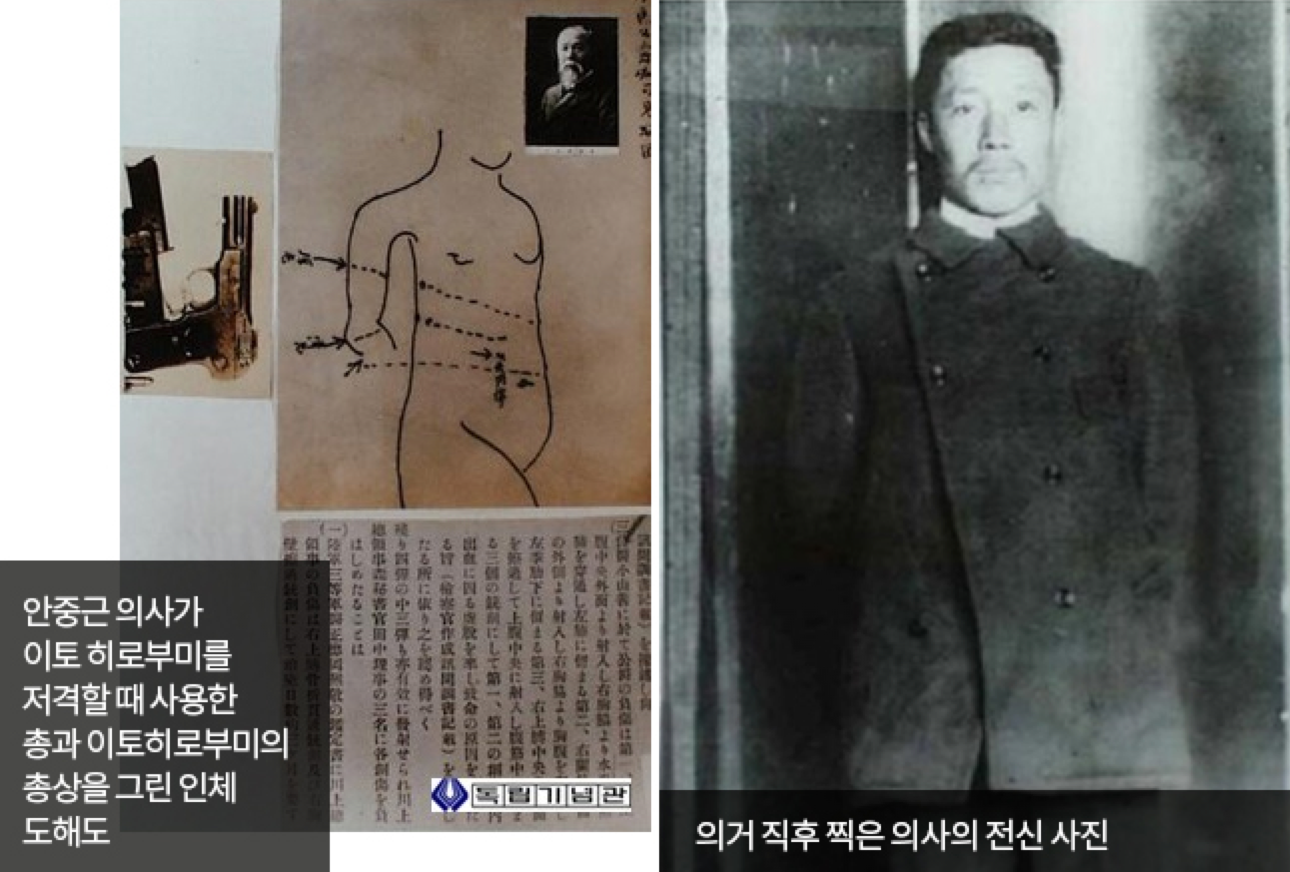
Diagram of Hirobumi's injuries (l); An (r)

Diagram of Hirobumi’s injuries (l); An (r)

In 1909 11 of An’s comrades were kidnapped, had their fingers broken and were killed by the Japanese, dying in their struggle for national freedom. In October of that year, Ito Hirobumi the architect of Japanese aggression towards Korea, was due to be in Harbin in China for talks with Russian financiers, and it was decided that he should be punished. An travelled to Harbin along with his like-minded comrade U Deoksun. An assassinated Hirobumi on the platform of the railway station. He was arrested, imprisoned and executed on the 26th of March 1910.

Ee Hyehun receives Saenuri [New World] party “Seochogap” nomination, Jo Yunseon drops out

KBS News (video at link)

20th of March 2016

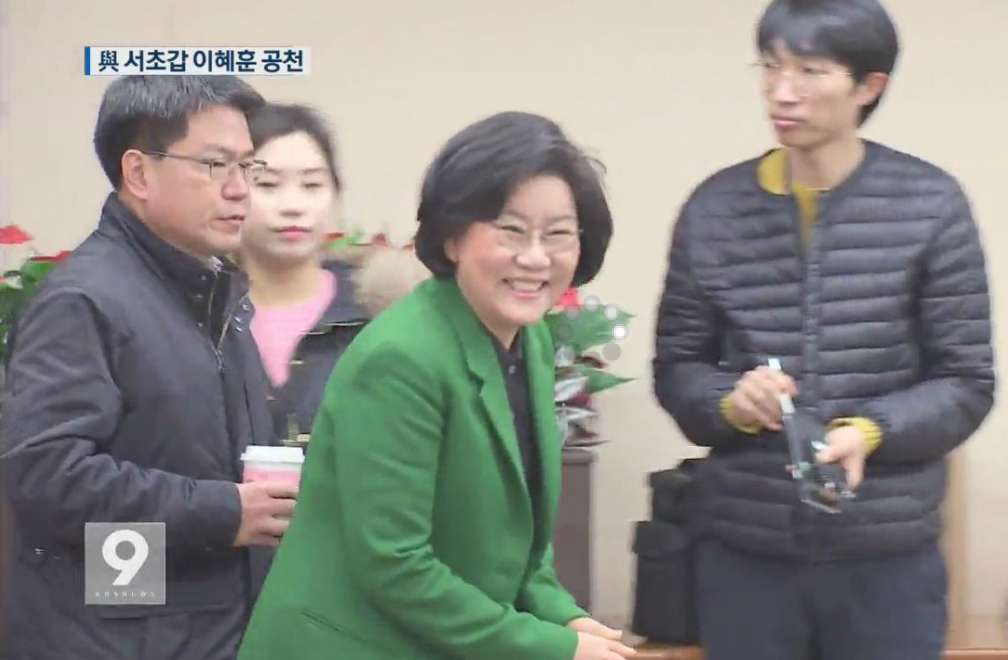
Candidate Ee Hyehun

Candidate Ee Hyehun

As part of the Saenuri party’s election process for the Seochgap elections, it was determined thatv previous member of parliament Ee Hyehun beat former head of the State Affairs Committee Jo Yunseon for the nomination. Jo is a member of the pro-president Bak Geunhye faction. Jo fought a hard battle, but observers have noted the strife which emerged from the nomination process.

After an intense conflict which had attracted concern, it appears that Daegu “Yuseungingye” candidate Gim Sanghun and pro-Bak faction member former Senior Secretary to the President for Public Affairs Yun Duhyeon moved to head off growing backlash caused by the strife of the election [by ensuring that Jo dropped out of the contest].

Member of parliament for active soldiers Shim Yunjo and MP Han Giho had earlier dropped out of the contest having conceded defeat. Seong Iljong, an adjunct professor at Goreyeo University and younger brother of deceased parliamentary liaison for Gyeonsangnam province Seong Wanjong, beat Chungnam Sasantae’s MP Gim Jaeshik for that nomination.

In Seoul Gu Seonghan, a former MP, Gim Hyojae, a former head of the State Affairs Committee and Choi Hongjae, who has held a previous post in the administration all earned a nomination. Member of the “Gim Museong Group” in Busan, MP Bak Minshik, and Gyeongsang MPs Han Seongyo and No Cheollae found themselves with their names on the ticket.

The nominations concerning Gim Museong himself, Seo Cheongwong and other supreme council membership positions are still to be announced. Ee Hangu, Saenuri Administrative Manager, said “I can’t say much about anything at the moment” when asked whether Gim Museong would be appointed as a representative to the supreme council.

Former 12-year-old Pro Baduk Player Ee Se-dol’s Life

BadukKBS News (Video at link)

16.03.2016

There are still traces of the young boy in the young man who has noted down a winning streak of 18 victories in a row and has 7 championship titles. It’s already been 10 years since he was posted to Seoul. His grandfather provides a testament as to his great skill at Baduk, recounting tales of Ee’s virtuoso play as a youth. As a 17-year-old 3rd-level player he recorded a victory over Yu Chang-hyeok, a 9th level pro. In 2000 he won 2 gold medals just 5 years after becoming eligible for grand tournament selection. He was pictured as a strong candidate for Most Valuable Player at that time.

Ee: I will try my best until I can do no more, so I won’t be regretful later. I think if one thinks like this, one cannot fail to obtain a good result.

Later he made an appearance on a programme about one-off talents where he was able to showcase his off-the-wall appeal. “Since I was a baby,” he said “my hair was always shorter… [now it’s longer].” Ee Se-dol, always a top-level adventurer – great effort!

Analysis: Baduk – more widely known as “Go” – is a strategic game with a very long history in Asia. Baduk originated in China but the Japanese version of the game has garnered the most attention internationally. Played with black and white stones on a grid board, the aim is to encircle an opponent’s pieces. Baduk is said to have more possible move combinations than there are atoms in the universe, and accordingly it’s a great test of skill and memory for players. The very finest Baduk players rely on intuition and experience to win. The tone of this video is illustrative; many viewers in the west may find it strange that a twelve-year-old boy was packed off to Seoul to further a career. However, pressure and expectation are a fact of life for many Korean from an extremely young age.